


Expert Commercial Moving Services for Businesses Nationwide: Comprehensive Solutions for Seamless Business Relocation
Commercial moving refers to professionally managed relocation services designed to move business assets, personnel, and operations safely and efficiently while minimizing downtime. This article explains how expert commercial moving and logistics services coordinate planning, secure handling, and staged execution to keep businesses operating through a transition. Readers will learn the core benefits of hiring commercial movers, the step-by-step process used to protect equipment and data, specialized services for sensitive assets, transparent pricing and insurance options, and how integrated storage and post-move support speed recovery. Companies facing office relocation, interstate expansions, or franchise rollouts will find practical guidance on project phases, IT and data center protocols, and vendor selection criteria for nationwide office movers. The article emphasizes operational continuity, risk mitigation, and measurable outcomes such as reduced downtime and secure chain-of-custody for critical equipment. After covering the topic-focused guidance, selective examples highlight how accredited full-service providers translate these practices into guarantees and flexible booking options to support a smooth transition.
Academic research further supports the structured approach to business moves, highlighting the importance of a comprehensive framework for successful workplace relocation.
Framework Model for Workplace Relocation Practices
The purpose of this study is to propose a framework model for workplace relocation. Published literature was reviewed to comprehend the broad aspects of workplace relocation. The current practices of workplace relocation were investigated by corporate
A framework for modeling the knowledge of workplace relocation, MA Hassanain, 2021
What Are the Key Benefits of Choosing Expert Commercial Moving Companies Nationwide?
Expert commercial moving companies deliver predictable, business-focused relocation outcomes by combining project management, specialized crews, and logistics systems that protect assets and keep people productive. The primary mechanism is integrated planning: a pre-move site survey produces an executable timeline and resource plan, which lowers risk and speeds re-setup at the destination. Businesses gain measurable value in reduced downtime, secure handling of sensitive equipment and records, and single-point accountability for complex, multi-site moves. These advantages make commercial movers essential for office relocation, corporate moving, and interstate business relocations where continuity and compliance matter most. Understanding these benefits helps organizations choose providers that align with operational priorities and service-level expectations.
The core benefits include:
- Minimized downtime: Phased scheduling and rapid reassembly reduce lost productivity during a move.
- Secure asset protection: Specialized packing, crating, and chain-of-custody controls limit damage and loss.
- Project management: Dedicated move managers coordinate crews, vendors, and IT to ensure timelines.
- Transparent terms: Clear pricing options and insurance reduce unforeseen costs and liability.
These advantages illustrate why businesses prioritize experienced commercial movers when planning relocations; the next section describes tactics movers use to limit operational disruption.
How Do Professional Business Movers Minimize Downtime During Office Relocation?

Professional business movers minimize downtime through a combination of phased execution, round-the-clock scheduling flexibility, and on-site project management that aligns move tasks with business cycles. They implement modular moves—relocating departments in stages—so critical functions remain operational while other areas transition, and they use after-hours or weekend shifts to perform disruptive tasks with minimal impact. Inventory tagging, pre-labeling of furniture and equipment, and a documented reinstallation plan streamline reassembly and reduce the time employees wait to resume work. Communication protocols, including single-point project managers and status dashboards, keep stakeholders informed and allow rapid adjustments, further compressing overall relocation time.
These practical tactics translate into predictable shorter outage windows and a faster return-to-work timetable, and understanding this operational playbook leads into what full-service relocation includes to make those tactics reliable.
What Makes Full-Service Commercial Relocation Efficient and Reliable?
Full-service commercial relocation bundles pre-move consultation, specialized packing, insured transport, installation, and optional storage into a single coordinated engagement that reduces vendor friction and client oversight burden. The mechanism of efficiency is consolidation: a single provider controls scheduling, quality, and liability, avoiding the coordination errors common with piecemeal vendors. Full-service teams use owned truck fleets and trained crews to maintain consistency in handling and timing, and they apply standardized packing and labeling protocols to preserve asset integrity. This all-in-one approach allows business leaders to focus on continuity while the moving provider handles logistics, permitting, and on-site installation.
By centralizing accountability and using proven workflows, full-service relocation reduces the number of decision points and accelerates project completion, which sets the stage for a step-by-step look at the commercial moving process.
How Does the Commercial Moving Process Ensure Smooth Office Relocation for Businesses?
A repeatable, phased commercial moving process maps objectives to tasks and timelines, reducing uncertainty and ensuring secure handoffs across planning, packing, transport, installation, and closeout. The essential mechanism is disciplined project governance: site surveys produce inventories, resource allocations, and contingency plans that guide every crew and subcontractor. Quality checks, chain-of-custody documentation, and IT migration windows are embedded into the schedule to protect sensitive systems and keep downtime predictable. This process-focused approach helps businesses of all sizes execute relocations without sacrificing security, compliance, or employee productivity.
The standard process can be summarized into clear steps that are commonly used to capture featured-snippet intent and support planning.
- Site survey and inventory: Inspect locations, tag assets, and build the move plan.
- Detailed timeline and staffing: Assign crews, schedule phases, and arrange permits.
- Packing and secure transport: Use specialized materials and climate control when needed.
- Installation and IT reconnection: Reassemble workstations and validate systems.
- Post-move QA and closeout: Final walkthrough, sign-offs, and claims handling.
Understanding the distinct stages of a commercial move is crucial, and scholarly work further dissects the critical factors influencing each phase of workplace relocation.
Factors Affecting Workplace Relocation Phases
The purpose of this paper is to holistically identify and assess the factors affecting the workplace relocation process during its various phases, namely: pre-relocation, relocation and post-relocation.
Review and assessment of factors affecting the workplace relocation process, MA Hassanain, 2020
These steps form the backbone of reliable commercial moves; the following table maps each phase to typical activities and timelines so teams can set realistic expectations.
| Phase | Activities | Typical Timeline |
|---|---|---|
| Planning & Survey | Site visit, inventory, risk assessment, timeline creation | 1–3 weeks |
| Pre-move Prep | Packing materials, labeling, IT backup, scheduling crews | 3–7 days |
| Move Execution | Loading, transport, unloading, on-site installation | 1–7 days (per phase) |
| Systems Reconnect | IT rack reassembly, network testing, equipment calibration | 1–3 days |
| Closeout & QA | Walkthrough, documentation, claims, final sign-off | 1–5 days |
This timeline table clarifies expectations for each phase and helps stakeholders plan internal communications and contingency coverage; next we examine the concrete sequence of tasks in corporate moving solutions.
What Are the Essential Steps in Corporate Moving Solutions?
Corporate moving solutions start with a comprehensive site survey and asset inventory, followed by a tailored schedule that aligns crew size and special equipment with move complexity. Project managers create a staffing plan and resource list, including packing and crating for fragile or regulated items, and coordinate IT migration windows to protect data availability. During execution, on-site supervisors verify each item against digital manifests and maintain chain-of-custody logs to reduce loss and simplify claims if necessary. Final steps include systems testing, ergonomics checks, and a closeout walkthrough to confirm completion and resolve punch-list items.
This ordered checklist clarifies responsibilities and timing, and it naturally leads to how packing and inventory handling are executed professionally to protect business assets.
How Is Packing, Unpacking, and Inventory Management Handled Professionally?
Professional packing and inventory management combine standardized labeling systems, digital manifests, and professional-grade materials to protect assets and speed reassembly. Crews categorize items by function and sensitivity, use custom crates for fragile equipment, and apply anti-static packing for electronics, while digital asset lists and barcode scanning enable rapid verification at each stage. Chain-of-custody policies document transfers and custody changes, which simplifies insurance claims and accountability if damage occurs. This structured inventory approach reduces unpacking time and helps operations resume quickly after relocation.
These inventory controls are especially critical when specialized services are required for technical equipment and regulated installations, which we explore next.
Which Specialized Services Do Expert Commercial Movers Offer for Business Assets?
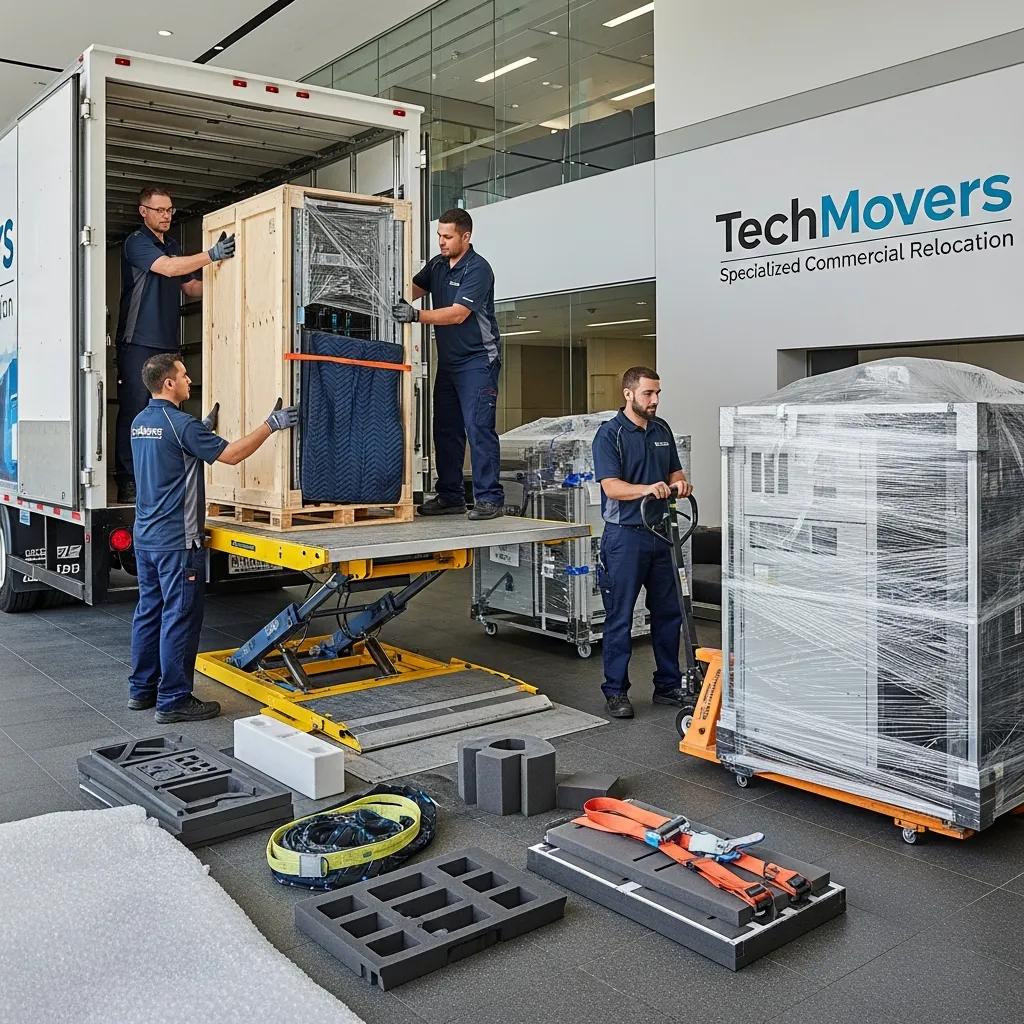
Specialized commercial movers provide targeted services such as IT and data center relocation, crating for fragile machinery, furniture disassembly and installation, and secure records handling to meet industry and equipment-specific requirements. These service categories exist because different assets demand different handling standards—server racks require rack-mount expertise, labs require environmental controls, and heavy industrial pieces require rigging and certification. Using certified crews and documented procedures, expert movers reduce risk and ensure compliance for sensitive relocations. Below is a comparison table that outlines common services, typical tasks, and when to engage each service.
| Service | Typical Tasks | When to Use |
|---|---|---|
| IT & Data Center Moving | Rack disassembly/rebuild, asset tagging, backup coordination | Server rooms, high-availability systems |
| Commercial Packing & Crating | Custom crates, anti-shock packing, fragile handling | Fine art, lab equipment, precision instruments |
| Furniture Disassembly/Installation | Labeling, reassembly, ergonomic setup | Office fit-outs, new layouts |
| Records & Document Handling | Secure transport, chain-of-custody, storage staging | Legal, financial, compliance-sensitive records |
This service matrix helps decision-makers match needs to capabilities and plan vendor selection; the next subsection details secure IT and data center migration protocols.
Underpinning these specialized services, some providers offer integrated end-to-end solutions that combine moving, storage, and post-move support to simplify complex projects and limit vendor management overhead. For example, full-service companies that operate owned truck fleets and provide a MoveMatch Guarantee reduce the risk of subcontracting gaps, while licensed, insured operations ensure regulatory compliance across states. These integrated options demonstrate how specialist capabilities pair with operational controls to deliver predictable results.
How Are IT Equipment and Data Center Relocations Managed Securely?
IT and data center relocations use rigorous protocols: pre-move backups, detailed asset tagging, rack-level documentation, anti-static packing, and chain-of-custody logs to preserve data integrity and hardware condition. Teams coordinate with in-house IT to schedule outages during low-impact windows, and they test backups and restore procedures before decommissioning primary systems to reduce service interruption risk. Climate-controlled transport and dedicated handling for sensitive components minimize thermal and mechanical stress, and certified technicians follow vendor-specific reassembly instructions to reboot systems safely. These measures combine to protect availability, data integrity, and hardware warranty compliance during moves.
The evolution of commercial moving, particularly concerning IT infrastructure, has been significantly shaped by the adoption of modern project management techniques.
Modern Project Management for Commercial Relocation & IT Systems
The application of modern project management techniques to the commercial relocation sector, particularly in regard to scheduling and the handling of IT systems, has transformed the relocation industry. The services offered by commercial relocation consultancies and some of the larger commercial removal companies now extend beyond the traditional ro
The changing face of relocation management, 1997
Understanding these security measures points to how industry-specific solutions adapt to regulated or fragile environments, which we address next.
What Industry-Specific Moving Solutions Cater to Unique Business Needs?
Industry-specific moving solutions tailor equipment handling, scheduling, and compliance to sectors such as healthcare, retail, laboratory research, and hospitality. For healthcare, movers coordinate with facility managers to meet infection-control schedules and handle diagnostic devices with calibrated packaging; for retail, moves often occur overnight to avoid sales disruption and include fixture reconfiguration; for labs, environmental controls and certified crating protect sensitive instruments and samples. These tailored approaches require permits, specialized rigging, and sometimes regulatory documentation to maintain continuity and compliance. By matching operational cadence and regulatory requirements, specialized movers reduce business risk and deliver sector-appropriate service.
These examples illustrate why businesses should select movers with relevant sector experience; the next section explains pricing models and insurance options that protect assets and budgets.
What Are the Transparent Pricing Models and Insurance Options for Commercial Moving?
Transparent pricing and clear insurance options are essential for budgeting and risk management in commercial relocation, and common models include fixed-rate quotes, hourly billing, and per-item pricing depending on move scope. A fixed-rate model bundles labor, equipment, and transport into a single guaranteed price useful for scope-defined moves, while hourly pricing fits uncertain or phased jobs where time is the main driver; per-item pricing can apply to specialized crating or unique assets. Insurance choices range from basic carrier liability to declared-value or valuation coverage that provides higher limits and broader protection. Below is a comparison table that helps businesses weigh models and select what fits their operational and financial risk profile.
| Move Type | Pricing Model | Value / When to Use |
|---|---|---|
| Single-site, defined scope | Fixed-rate | Predictable budget; best for complete office moves |
| Uncertain scope / phased moves | Hourly | Flexible for staging and variable workloads |
| High-value or special items | Per-item / Declared value | Accurate asset-level pricing and higher protection |
| Nationwide, consolidated moves | Consolidated fixed-rate | Efficiency via route optimization and guaranteed slots |
This table clarifies how model choice affects predictability and exposure; the following subsection outlines the main cost drivers for nationwide commercial quotes.
In practice, transparent vendors combine clear quote components with options to reserve services using modest deposits and financing options that support cash-flow management during transitions. For instance, some full-service providers offer a low deposit to secure scheduling and “move now, pay later” financing to spread costs, which helps organizations proceed without heavy upfront capital strain. These transactional details help businesses plan cash flow around relocation while preserving the protections described here.
How Is Competitive Pricing Structured for Nationwide Commercial Moves?
Competitive nationwide pricing reflects distance, total weight/volume, special equipment needs, required permits, and timing; consolidation and route planning lower per-location costs by optimizing truckloads. Carriers build quotes from core components—labor, equipment, transport, and add-ons such as packing or climate-controlled transport—and adjust for peak-season surcharges or expedited windows. Fixed-rate guarantees are valuable for multi-site rollouts because they lock in costs and simplify budgeting, while hourly models offer flexibility when phase timing is uncertain. Understanding these cost drivers helps procurement teams evaluate quotes and choose the most cost-efficient combination for interstate business relocations.
This pricing breakdown informs insurance selection and claims practices, which we describe next to ensure assets are adequately protected.
What Commercial Moving Insurance Protects Business Assets During Relocation?
Commercial moving insurance options range from limited carrier liability—tied to weight or per-pound valuations—to declared-value or valuation coverage that compensates based on full replacement value or agreed amounts. Basic carrier liability may suffice for low-risk furniture, but high-value equipment, server racks, and regulated devices typically require higher valuation coverage or specific endorsements. Businesses should verify exclusions, required documentation for claims, and the provider’s claims-handling procedures before finalizing coverage. Maintaining pre-move inventories, photos, and serial-number records streamlines claims and demonstrates diligence if damage occurs.
Choosing appropriate insurance reduces financial exposure and complements operational safeguards; with pricing and insurance clarified, businesses can consider integrated storage and post-move support to smooth transitions, which follows next.
How Can Businesses Benefit from Integrated Commercial Storage and Post-Move Support?
Bundling commercial storage with moving services provides staging options, overflow capacity, and secure interim holdings for furniture, inventory, or equipment during phased relocations. Integrated storage supports staged rollouts by allowing parts of an operation to be kept in climate-controlled or racked facilities until installation windows are ready, reducing onsite clutter and expediting staged setups. Post-move support services—furniture installation, IT reconnection, signage placement, and employee relocation assistance—help organizations resume full operations faster and reduce the administrative load on internal teams. Together, storage and post-move support create continuity options that align with complex rollout strategies and operational constraints.
The following list outlines common storage and post-move services businesses use to retain continuity and accelerate recovery after relocation.
- Short-term staging: Temporary secure storage for phased deployment and furniture staging.
- Climate-controlled warehousing: Protects temperature-sensitive equipment and records.
- Inventory staging & kitting: Prepares grouped items to speed installation at the destination.
- On-site installation services: Furniture assembly, modular workstation setup, and signage.
These integrated capabilities reduce risk and simplify logistics; the next subsection explains storage types and when to use them.
What Commercial Storage Solutions Are Available for Business Inventory and Equipment?
Commercial storage options include standard warehousing, climate-controlled units, racked storage for palletized goods, and secure vaults for sensitive records, each offering different security and environmental controls.
Standard storage is cost-effective for bulky, non-sensitive items, while climate-controlled facilities protect electronics, instruments, and archival records from humidity and temperature swings. Racked warehousing supports inventory staging with forklift access and SKU management, and many providers integrate digital inventory systems for real-time visibility. Choosing the right storage depends on duration, environmental sensitivity, and integration with inventory management to ensure rapid retrieval when installation windows open.
Selecting the proper storage solution ensures assets remain secure and accessible and leads into how post-move services support people and systems after relocation.
How Do Post-Move Services Facilitate Office Setup and Employee Relocation?
Post-move services focus on finishing tasks that restore productivity quickly: furniture reassembly and ergonomic setup, IT reconnection and testing, signage and workspace labeling, and employee move assistance programs that support relocation logistics.
Teams coordinate with HR to communicate schedules and workstation assignments, while technicians validate network performance and application access before employees return. Ergonomic assessments and workstation calibration reduce downtime from discomfort or inadequate setups, and move managers provide a single point of contact for punch-list resolution.
These post-move actions close the loop on relocation and help businesses resume normal operations with minimal friction.
Beyond the core moving services, businesses often find value in supplementary offerings. For instance, efficient junk removal can be crucial for clearing out old equipment or unwanted items, ensuring a clean and organized transition to the new space.
For businesses evaluating providers, some full-service moving companies present trust signals and transactional options that streamline contracting and protect budgets. For example, companies positioned as nationwide full-service movers may offer a MoveMatch Guarantee, owned truck fleets (reducing subcontracting risk), and licensed, insured operations to ensure predictable outcomes. Additionally, modest deposit requirements and “move now, pay later” financing options can ease cash-flow constraints while locking in schedule commitments through low deposits. These vendor-level offerings integrate directly with the operational safeguards and pricing transparency described in this article and help organizations convert planning into action.
- Guarantees and owned equipment: Reduce subcontracting variability and provide accountability.
- Low deposit and financing: Preserve budget flexibility while securing move dates.
- Licensed and insured operations: Protect against regulatory and liability gaps.