


Reliable, Affordable Short-Distance Moving Solutions
Local and short-distance moving means relocating within the same city or state over relatively brief travel distances, and getting it right saves time, money, and stress. This article explains what short-distance and intrastate moving covers, how costs are calculated for residential local moves, and practical steps you can take to prepare for a smooth move. You will learn how to compare hourly versus fixed-rate options, which ancillary services (packing, junk removal, storage) matter for small relocations, and how local knowledge affects timing and permits. The guide also outlines key cost drivers, gives a compact moving checklist you can use immediately, and describes where experienced local teams operate to reduce surprises on moving day. Throughout, actionable tips on choosing a reliable mover — including what trust signals to look for — will help you find affordable, high-quality short-distance movers and request an accurate quote.
Research further highlights the significant financial implications and trends in local, intracounty mobility.
Understanding Intracounty Mobility and Moving Costs
rates explain about half of all local, intracounty mobility decline, effectively none of the decline in interstate mobility is attributable to these factors. This suggests that the typical move is more costly and
Decomposing American immobility: Compositional and rate components of interstate, intrastate, and intracounty migration and mobility decline, TB Foster, 2017
What Are Short-Distance and Local Moving Services?
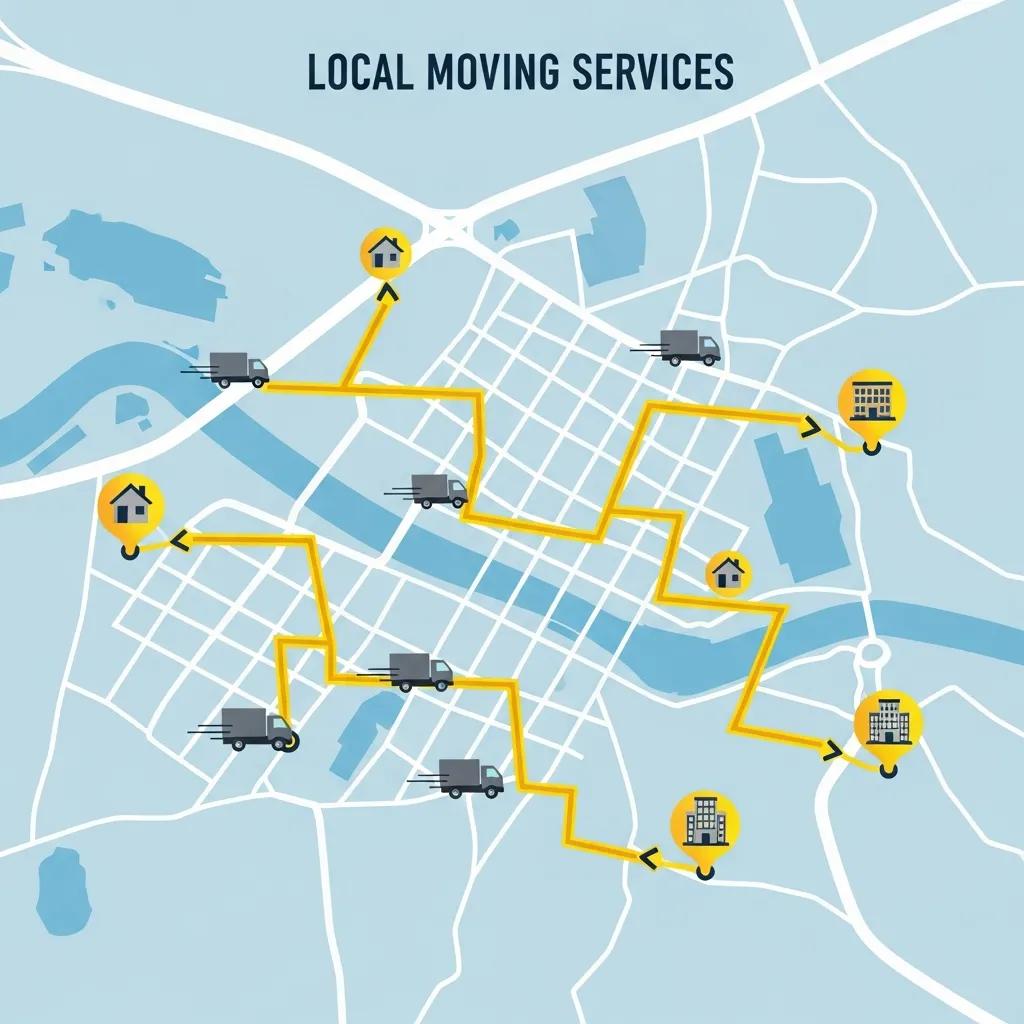
Short-distance and local moving services handle relocations that remain within the same metropolitan area or state and usually involve shorter transit times and simplified regulatory requirements. These services focus on packing, loading, secure transport, unloading, and optional unpacking or storage for moves that typically range from a few blocks to roughly under 50 miles, although local providers often measure moves by time rather than strict mileage. Local moving is ideal for apartment-to-apartment transfers, condo moves, and intracity household relocations where crews can complete the job in a single day. Understanding the scope and typical use-cases for local moving helps you select the right service model and budget effectively for labor, time, and supplies.
How Is a Short-Distance Move Defined?
A short-distance move is generally defined as a relocation that stays within the same state or metropolitan region and is measurable in minutes to a few hours of driving rather than overnight transport. Practically, many local movers treat jobs expected to finish in a single day as short-distance, using hourly billing or fixed-day quotes rather than interstate moves pricing models. Regulators also differentiate intrastate moves from interstate moves by requiring state-level filings instead of federal interstate authority, which affects paperwork and insurance rules. Knowing this distinction matters because it influences types of insurance coverage offered and whether hourly versus flat-rate billing is typical for your move.
Academic studies further elaborate on how the scope of a move, whether intracounty or intercounty, directly impacts the overall moving costs.
Local Moving Costs: Intracounty vs. Intercounty
In addition, labor market conditions are local, meaning that employment opportunities differ across locations. The costs of moving are larger for intercounty moves than for intracounty moves, but the main moving costs such as
Fixed‐rate mortgages, labor markets, and efficiency, K Lee, 2018
What Types of Moves Qualify as Local or Intrastate?
- Apartment-to-apartment moves within the same city, including elevator or stair logistics for multi-story buildings.
- Small house or condo relocations inside the same county or nearby suburbs that can be completed in one day.
- Local business or office relocations that transfer desks, modular furniture, and electronics across nearby sites.
- Senior moves and downsizing projects that require additional packing or short-term storage within the same region.
These qualifying move types share short transit times and reduced paperwork compared with interstate moves, and they often allow simpler scheduling windows and quicker estimates.
Why Choose Your Hometown Mover for Reliable Local Moving?
When choosing a mover for short-distance relocations, prioritize transparent pricing, reliable crews, and verifiable credentials that reduce risk and hidden costs. Look for licensed and insured providers with clear guarantees, positive customer reviews, and financing or payment options that make moving accessible. These signals indicate operational maturity and customer-centric policies that help ensure work is completed on time and with proper care. Vetting these attributes early narrows your choices to companies that can reliably handle the logistics, protect belongings, and deliver predictable arrival times and costs.
How Does the MoveMatch Guarantee Ensure Best Pricing?
The MoveMatch Guarantee functions as a best-price safety net: if you find a comparable written local moving quote from another reputable provider, the guarantee aims to match or beat that price so you enjoy lower cost with price confidence. In practice, customers present a comparable estimate and the guarantee is applied after verifying the competitor quote against service parity and scheduling conditions. For consumers, this reduces the need for extensive shopping and simplifies decision-making by converting price comparison into a single confirmation step. The result is less time spent negotiating and a clearer path to booking a reliable local crew at a competitive rate.
What Does 0% APR Financing Offer for Your Move?
0% APR financing under a “MoveNow, Pay Later” program lets customers spread move costs over time without interest, lowering the barrier to booking sooner when timing or cash flow is tight. Eligibility typically depends on a simple application and approved terms that permit deferred payment without added financing charges during the promotional period. This option helps households proceed with essential relocations—such as job-related or time-sensitive moves—without delaying plans to save for a lump-sum payment. If you need payment flexibility, financing provides a predictable monthly obligation that still preserves full moving services and scheduling options.
What Local Moving Services Does Your Hometown Mover Provide?
Local moving providers package several core services for short-distance residential and small commercial moves, allowing you to choose labor-only help or full-service options that include packing, supplies, and storage. Common offerings include hourly local moving for flexible short jobs, fixed-rate local moving for defined scope moves, packing services in full or partial modes, moving labor for loading/unloading, junk removal for decluttering, and moving and storage when timing requires interim warehousing. These options let customers balance budget and convenience, choosing only the services needed to get settled quickly and safely.
What Are the Differences Between Hourly and Fixed-Rate Local Moving?
Hourly local moving bills by crew size and time on the job and is best for small, uncertain, or short-duration moves where speed and flexibility matter; fixed-rate local moving provides a flat price based on an inventory or survey and suits moves with clear scope and timelines. Hourly billing typically multiplies the number of movers by an hourly rate and travel time, making it efficient for short trips with light loads, while fixed-rate quotes reduce the risk of surprise charges for defined work and longer jobs. Choosing depends on complexity: choose hourly for quick apartment moves and fixed-rate for larger homes or when you prefer price certainty.
Further analysis of pricing models often explores the nuances between hourly and fixed-rate structures, considering factors like time-of-use and overall price variation.
Hourly vs. Fixed-Rate Moving Service Pricing
For each month, the hourly TOU rate is set at the average for the month. The price variation explained by this TOU relative to the fixed rate is small, and recommendations for moving away from flat rates, there
Time-of-use rates and real-time prices, WW Hogan, 2014
Introductory comparison table below clarifies the practical attributes of each billing model.
| Pricing Model | How It’s Billed | Typical Use-Case | Pros / Cons |
|---|---|---|---|
| Hourly local moving | Charged per mover per hour including travel time | Small apartments, last-minute moves | Pros: Flexible, easy to scale. Cons: Costs vary with delays |
| Fixed-rate local moving | Flat quote based on inventory or survey | Larger homes with clear scope | Pros: Predictable cost. Cons: Less flexible for scope changes |
| Moving labor only | Charged per hour for loading/unloading help | DIY transport or truck rentals | Pros: Cheapest for labor-only tasks. Cons: No transport provided |
| Moving and storage | Combined flat or hourly for move plus storage fees | Staggered move dates, staging | Pros: Solves timing gaps. Cons: Additional monthly fees |
This table highlights how each approach maps to typical needs and the trade-offs between flexibility and price certainty. Understanding these differences helps you choose the model that best matches your short-distance move.
How Do Packing and Junk Removal Services Support Your Local Move?
Packing services range from supplying materials only to full-service packing where trained crews wrap fragile items, disassemble furniture, and label boxes for efficient unloading at your new address. Junk removal is useful either before a move to reduce volume and lower costs or after unloading to clear space quickly and responsibly. These services reduce on-site labor time and minimize damage risk by using professional techniques and protective materials, which often shortens total time-on-job and can lower hourly costs for moves billed by the hour. For short-distance relocations, selective packing or targeted junk removal often provides the best balance of cost and convenience.
Before the table below, note this comparison clarifies typical inclusions.
| Service | Included Tasks | Typical Benefit |
|---|---|---|
| Full packing | Materials, full crew packing, labeling | Saves time and reduces damage risk |
| Partial packing | Fragile items or rooms only | Controls cost while protecting valuables |
| Junk removal | Hauling and disposal of unwanted items | Lowers volume and hauling time |
| Moving supplies | Boxes, tape, protective wraps | Ensures proper protection during transit |
When you choose the right mix of packing and junk removal services, you shorten the moving timeline and reduce surprises on moving day, enabling a faster, safer transfer of your belongings.
How Much Do Reliable Local Movers Cost for Short-Distance Relocations?

Local moving cost depends on billing model, crew size, distance, complexity, and any additional services like packing or storage, and typical hourly ranges and sample fixed-rate estimates provide practical budgeting guidance. For hourly local moves, typical market ranges are reflected in per-mover hourly rates multiplied by travel time and total job hours; fixed-price jobs vary with inventory and access constraints. Key cost drivers such as flights of stairs, bulky items, and narrow access points add labor time and therefore price, while optional services like packing or disposal add discrete line items. Understanding these factors helps you use a local moving cost calculator or request a precise estimate with clear assumptions.
What Factors Influence Local Moving Costs?
Several core factors reliably influence the final price of a short-distance move, each adding measurable time or materials to the job.
- Distance and travel increase total crew hours when traffic or parking rules require extra handling.
- Crew size and hourly rates determine base labor costs and how quickly the job proceeds.
- Access challenges like stairs, elevators, narrow hallways, and long carries slow loading/unloading and add minutes per item.
- Packing, disassembly/reassembly, and special handling for pianos or large furniture require extra labor and materials.
Introductory table below shows estimated impact ranges for common cost factors.
| Cost Factor | Description | Typical Impact on Price |
|---|---|---|
| Distance / travel | Time spent moving between locations | Adds hourly or fuel surcharge (moderate) |
| Crew size | Number of movers required | Each additional mover raises hourly cost (high) |
| Stairs / access | Flights, long carries, elevator use | Adds labor minutes per item (moderate-high) |
| Packing services | Full or partial packing needs | Adds flat fee or hourly packing charge (moderate) |
| Special items | Pianos, pool tables, antiques | Requires equipment/specialist crew (high) |
This breakdown helps you anticipate which aspects of your move will most affect price and where you can intervene to control costs, such as decluttering prior to the move or scheduling off-peak times to reduce travel delays.
How Can You Get an Accurate Local Moving Quote?
To get a precise quote, provide a detailed inventory, photos or a virtual walk-through, and accurate access information including building rules and parking constraints; these items let a coordinator scope labor needs and produce a written estimate. The process typically follows three clear steps: list items and rooms, document access and measurements with photos or a short video, and schedule a virtual or in-person survey if required for large or complex moves. Virtual surveys save time and still allow movers to calculate labor, truck size, and whether special equipment is needed. Requesting a written quote that itemizes labor, travel time, packing, and any potential surcharges reduces disputes and helps you compare like-for-like offers.
After you understand how quotes are generated, you can request guarantees or price-match policies to protect your budget. For customers who value transparent pricing and price confidence, Your Hometown Mover offers a MoveMatch Guarantee and a MoveNow, Pay Later financing option with 0% APR to help secure the booked price and flexible payment terms. To get a tailored, accurate quote, contact a move coordinator and provide the inventory and access details above; you can also call (855) 978-7317 to speak with a representative about transparent pricing and guaranteed best-price options.
How Can You Prepare for a Smooth Local Move?
Preparation reduces on-the-day surprises and shortens crew time, which directly lowers cost for hourly moves and keeps fixed-rate schedules on track. Planning includes decluttering, scheduling movers early, preparing clear labeling, and assembling an essentials box so daily routines resume immediately after the move. Taking a few systematic steps ahead of time also helps with insurance clarity and reduces handling risk for fragile items. Below are prioritized actions that produce the biggest time-and-cost savings when moving locally.
What Is the Ultimate Local Moving Checklist?
Below is a concise checklist of high-impact tasks to complete before moving day, designed for short-distance residential moves and suitable for apartments, condos, and small houses.
- Declutter and donate or discard unwanted items to reduce volume and cost.
- Confirm your mover booking and provide access details and contact numbers.
- Pack nonessentials in advance and label boxes by room and priority.
- Prepare an essentials box with toiletries, chargers, documents, and a change of clothes.
- Clear walkways and measure large furniture to ensure fit through doors and elevators.
Completing these steps reduces on-site labor and prevents delays, which in turn minimizes overall cost and stress. The next step is handling utilities and notified address changes in a timely sequence to avoid service disruptions.
Introductory note: the checklist above is actionable and designed to be completed in the two weeks prior to moving.
How Should You Pack and Transfer Utilities for a Local Move?
Begin utility and service transfers 2–4 weeks before moving day to ensure uninterrupted power, internet, and essential services at your new address, and finalize cancellations or start dates at least one week out. Use a labeling system that specifies room and box contents and mark fragile boxes clearly to prioritize handling; this speeds unloading and unpacking and reduces accidental damage. For fragile items, use protective padding, proper box sizes, and crew-assisted packing if you prefer professionals to handle delicate pieces. A short timeline and prioritized packing plan help you coordinate with movers and reduce the on-site hours paid to crews.
Before moving day, confirm parking permits or loading zone access with building management and leave clear instructions for the crew; these small steps avoid bottlenecks that extend job time. Preparing utilities and packing in a prioritized way ensures that the crew can work efficiently when they arrive, minimizing billed hours and easing transition.
Where Does Your Hometown Mover Offer Local Moving Services?
Local knowledge matters: movers who operate routinely in your region understand permitting, route timing, and typical access challenges, which shortens job time and reduces unexpected charges. The company provides coverage across key New York and Florida regions, deploying local crews familiar with metropolitan conditions, permitting rules, and common building policies. Regional experience also supports better scheduling and more accurate quotes because coordinators can anticipate constraints like narrow streets or tight elevator windows.
Which Cities and Regions Are Covered in New York and Florida?
- New York coverage: Capital Region, Hudson Valley, and New York City metropolitan moves.
- Florida coverage: Gulf Coast and South Florida regional moves, including suburban and urban local relocations.
- Availability: Local crews in these regions offer short-notice and scheduled moves across city and suburban routes.
How Does Local Knowledge Enhance Your Moving Experience?
Local crews apply route familiarity, building and permit knowledge, and experience with neighborhood logistics to complete moves faster and with fewer surprises, which reduces time-on-job and therefore cost. Familiarity with loading zones, elevator booking windows, and common building policies means coordinators can plan optimal loading sequences and vehicle placements. Local expertise also helps solve on-site issues—such as tight staircases or restricted parking—quickly, preventing extended downtime and additional billed hours. These operational advantages make a measurable difference in both the smoothness of the move and the predictability of final cost, which is why regional experience is a key selection criterion.
For personalized assistance in these service areas or to request a free quote with transparent pricing and the MoveMatch Guarantee, you can call (855) 978-7317 to connect with a move coordinator who can schedule a virtual survey and discuss financing options.