


The Ultimate Moving Checklist: Your Step-by-Step Guide to a Smooth Move
Moving is a complex project that combines logistics, timing, and practical decision-making; a well-constructed moving checklist turns that complexity into manageable tasks. This guide is a complete relocation guide designed for individuals, families, and businesses who want a structured moving timeline, packing strategies, moving day preparation, and post-move setup. Many people lose time and money during moves because they skip pre-move planning, mix fragile items with bulk packing, or fail to prioritize essentials; this checklist solves those problems by sequencing actions, assigning deadlines, and recommending resources. You will learn how to plan eight weeks out, what to pack and when, what must be ready on moving day, and which post-move tasks accelerate settling in. The article also highlights practical choices—DIY vs. professional services—and offers concrete tools such as EAV comparison tables and ready-to-use lists for featured-snippet style answers. By following this moving timeline and checklist, you reduce stress, protect belongings, and control moving cost factors while keeping options like financing and storage in view.
What Is the Ultimate Moving Checklist and Why Is It Essential?
The ultimate moving checklist is a prioritized, time-bound plan that enumerates every moving task from pre-move planning through post-move setup, and it works by converting an open-ended relocation into discrete, schedulable actions. This approach reduces decision fatigue and prevents common errors like missed address updates, last-minute packing, and overlooked inventory, producing consistent time savings and lower unexpected costs. Use the checklist as your single source of truth for vendor bookings, inventory, and essential-day coordination so you can delegate tasks confidently and monitor progress. Below are the top benefits framed for quick reference and featured-snippet potential.
- Stress reduction: Prioritizing tasks prevents last-minute crises and clarifies responsibilities.
- Time savings: Scheduling and batching tasks streamlines packing and vendor coordination.
- Cost control: Early vendor comparison and inventory reduce surprise fees and unnecessary services.
The importance of strategic planning in achieving financial efficiency during a move is further supported by academic research.
Project Management for Cost-Effective Relocation
Project managers have responsibility for the planning, execution and closing of any project such as construction projects, which requires improvement for cost and time related productivity, efficiency and effectiveness gains. There is a planned relocation by some departments in the University to the allocated building in MediaCityUK. This move highlights the need for a well managed, cost effective and sustainable relocation
PROJECT MANAGEMENT OF A RELOCATION PROJECT SUPPORTED BY BUILDING INFORMATION MODELING, Y Arayici, 2011
A checklist functions best when paired with the right resources and vendors; for readers considering professional help, Your Hometown Mover offers full-service moving solutions and dedicated moving coordinators that align with checklist tasks. Mentioning a trusted partner at this stage provides readers a vetted option for staging and executing the plan without replacing the educational focus. Understanding how a checklist reduces stress leads naturally into a closer look at the mechanisms behind those benefits.
How Does a Moving Checklist Reduce Stress and Save Time?
A moving checklist reduces stress by converting overwhelming projects into sequenced tasks, and it saves time by promoting batching and prioritized scheduling that minimize context switches. Planning early—creating an inventory, booking services, and assigning deadlines—prevents common bottlenecks and last-minute rushes, so you avoid premium fees and availability problems. An example scenario: starting decluttering and inventory 8 weeks out enables you to sell, donate, or schedule junk removal well before moving week, cutting packing volume and mover hours. These operational gains also improve psychological outcomes because lowering uncertainty reduces cognitive load and decision fatigue. Recognizing those mechanisms sets up the next step: translating timeline phases into actionable dates and vendor decisions.
This systematic approach to task sequencing and scheduling is a core principle of effective project management in relocation.
Relocation Schedule Planning & Project Management
studies related to project management, project planning, and relocation projects. The literature review sets up a baseline for the case study research on relocation schedule planning.
Project Management Schedule Planning for a Short-Distance Factory Relocation: A Case Study, 2023
What Key Steps Are Included in a Comprehensive Moving Guide?
A comprehensive moving guide breaks the move into four phases—pre-move, packing, moving day, and post-move—with clear milestones, required supplies, and service choices that map to your personal timeline and budget. Key steps include creating a room-by-room inventory, scheduling movers and insurance, assembling packed and labeled boxes, and running a final walkthrough with documentation. The guide also recommends when to consider professional services such as partial or full-service packing, portable storage, or junk removal to reduce workload and risk. Use the short numbered checklist below to frame your planning and link tasks to the relevant sections of this article.
- Pre-move planning: Budgeting, inventory, and vendor selection.
- Packing phase: Room-by-room packing, fragile protection, and labeling.
- Moving day: Essentials box, crew coordination, and final checks.
- Post-move: Utilities, address updates, and settling-in organization.
This high-level map clarifies where decisions like hiring pros or using storage solutions fit into your schedule, and the timeline planner below details actionable tasks for each phase.
For those planning a move within the same city or a short distance, dedicated local moving services can streamline the process, offering tailored support for your specific needs.
How to Plan Your Move: The Complete Moving Timeline Planner
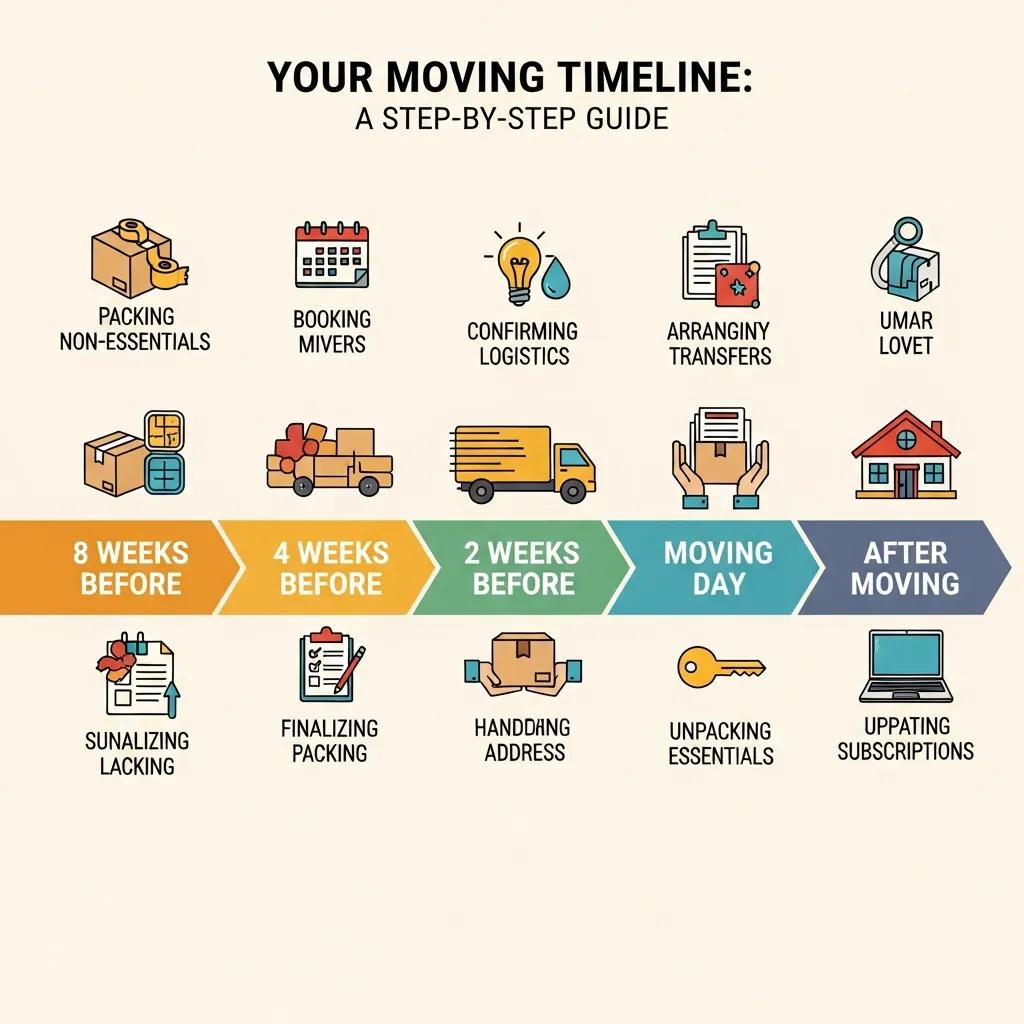
A moving timeline structures tasks across weeks so you know exactly when to book movers, begin packing, and arrange utility transfers; following a timeline reduces overlaps and ensures key vendors remain available. Start eight weeks out with research and budgeting, confirm bookings by four weeks, and intensify packing two weeks before moving day while finalizing logistics during moving week. The table below compares timeline phases with primary tasks, estimated time commitments, and recommended service actions so you can convert time windows into executable steps.
Introductory timeline table: this table maps each phase to core actions and typical time estimates to help you prioritize and schedule.
| Phase | Primary Tasks | Estimated Time |
|---|---|---|
| 8+ Weeks Before | Create budget, research movers, start decluttering | 5–10 hours |
| 4 Weeks Before | Confirm mover, gather supplies, pack non-essentials | 8–20 hours |
| 2 Weeks Before | Pack most items, label boxes, arrange transfers | 10–25 hours |
| Moving Week | Pack essentials, confirm logistics, final walkthrough | 6–12 hours |
This structured timeline converts broad planning into measurable steps and highlights when to lock in services or financing options that affect moving cost decisions. With the timeline clear, the next subsections outline specific tasks for the 8-week and 4-week windows.
Understanding the various components and calculations of these costs is crucial for effective financial planning.
Understanding & Managing Relocation Costs
Understand what is meant by relocation cost. Explain the management and disbursement of relocating costs. Critically evaluate the calculation of relocation costs.
Managing Relocation Costs, M Oyelere, 2021
What Should You Do 8 Weeks Before Moving Day?
Eight weeks before moving day you should create a realistic moving budget, compile a full inventory, and begin decluttering; these actions set the scope for vendor quotes and packing needs. Research multiple moving services, check licensing and insurance, and identify any specialized needs like long-distance logistics or commercial moving to inform accurate estimates. Begin donating, selling, or scheduling junk removal for items you won’t move, which reduces volume and lowers costs; consider storage options if items require temporary holding. These early planning steps lead directly to confirmation and supply-gathering around the four-week mark, which ensures a smoother transition into packing.
Which Tasks Are Critical 4 Weeks Before Moving?
At four weeks out confirm your mover, book any professional packing or storage, and acquire packing supplies in the quantities your inventory indicates. Start systematic packing room-by-room, prioritize non-essentials, and label boxes with room and content summaries to speed unpacking; also verify mover insurance coverage and estimate hours for labor. Notify important parties of your upcoming move—banks, subscriptions, and service providers—to begin the address-change process and schedule utility transfers. Completing these tasks prepares you for the final packaging push in the two-week window and reduces last-minute coordination on moving day.
What Are the Best Strategies for Packing for a Move?
Effective packing strategies balance protection, speed, and cost by choosing the right materials, box sizes, and method—room-by-room packing, staging fragile items, and systematic labeling are essential tactics. Decide early whether to DIY, use partial pro pack services, or hire full-service packers; cost drivers include labor hours, volume, and specialized packing for high-value items. Below is an EAV-style table comparing common packing approaches, which helps you select the appropriate method for your budget and timeline.
Packing approaches comparison table: this table outlines cost drivers, best-use scenarios, and required supplies for each approach.
| Packing Approach | Cost Drivers | Best-Use Scenario |
|---|---|---|
| DIY Packing | Time, supplies, number of helpers | Tight budget, flexible schedule |
| Partial Pro Pack | Labor for fragile/valuable items | Mixed workload, time savings needed |
| Full-Service Pack | Labor, materials, insurance | High-value or time-constrained moves |
Choosing a packing approach influences supply needs and scheduling, and the next subsections explain fragile-item techniques and essential supplies.
How Do You Pack Fragile Items Safely and Efficiently?
Packing fragile items relies on three principles: cushion, containment, and clear labeling; use appropriate padding materials, correct box sizes, and double-box high-value pieces to absorb shock. Wrap individual items in bubble wrap or packing paper, nest dishes vertically with separators, and use foam or sleeves for electronics; place heavier items at the bottom of boxes and avoid overpacking. Mark fragile boxes clearly with handling notes and indicate orientation so movers can stack appropriately, and consider professional packing for antiques or expensive electronics to ensure insurance coverage and minimize risk. These methods reduce breakage and tie into decisions about whether to hire partial or full-service packers for added protection.
What Essential Packing Supplies Do You Need?

A prioritized packing supplies list keeps procurement efficient: gather medium and large boxes, strong packing tape, bubble wrap, packing paper, permanent markers, and furniture covers as a baseline for most household sizes. Specialty items like wardrobe boxes, mirror boxes, appliance dollies, and mattress covers are helpful for particular needs and reduce handling damage during transit. Consider eco-friendly options—reusable plastic bins or recycled boxes—when possible to reduce waste and potentially lower disposal needs after the move. Knowing the supplies you need dovetails with selecting a packing approach and deciding whether professional packers should supply materials.
What Are the Must-Have Moving Day Essentials?
Moving day essentials are the items and documents you keep with you to ensure comfort, first-night functionality, and administrative continuity; assemble an essentials box and checklist to avoid searching through dozens of boxes. Essentials include medications, important documents, chargers, a basic toolkit, snacks, bedding, and toiletries so you can operate in your new home immediately. The table below lists essentials-box items with reasons and example quantities to help you prepare a well-rounded kit for the first 24–48 hours.
Essentials box table: this table lists common essentials, why they matter, and suggested examples/quantities.
| Item | Reason / Usage | Example |
|---|---|---|
| Medications | Immediate health needs | 1–7 day supply |
| Important Documents | IDs, leases, insurance | Folder or envelope |
| Chargers & Electronics | Communication & navigation | Phone charger, power bank |
| Basic Tools | Assembly and minor repairs | Screwdriver kit, flashlight |
| Toiletries & Bedding | First-night comfort | Toothbrush, towel, sheets |
Having an essentials box prevents last-minute stress and helps you manage movers and payments without hunting for necessities; consider professional moving-day coordination if you need same-day or expedited services. If you require immediate assistance on moving day, Your Hometown Mover provides options including full-service moving and same-day coordination features with a dedicated moving coordinator and live GPS tracking for long-distance moves, which can simplify on-the-day logistics and provide peace of mind. Organizing essentials prepares you for the procedural steps and timing of a smooth moving day.
How Do You Organize Your Moving Day for a Smooth Experience?
Organize moving day with a timed plan: begin the morning with a final walkthrough, confirm arrival time and scope with the crew, and allocate roles for supervising, pet care, and kids’ activities to prevent interruptions. Maintain a single-point contact for the team—ideally the person with the inventory and bill of lading—and document items loaded versus your inventory using photos or checklists. Keep payments, ID, and mover documentation handy, and conduct a final walkthrough when loading finishes to confirm nothing is left behind; this approach protects against disputes and clarifies hand-off procedures. These coordination steps tie directly into the next requirement: packing an essentials box with everything you need for the first night.
What Items Should Be in Your Moving Day Essentials Box?
Your essentials box should include the top items you’ll need in the first 24–48 hours to avoid interruption: medications, identification, chargers, a change of clothes, basic cookware, toiletries, and bedding. Include a small toolkit for immediate assembly, basic cleaning supplies for quick touch-ups, and a list of emergency contacts and utility account numbers to speed activation at the new home. Rank items by immediate necessity—medications and documents first, then comfort and tools—so you can prioritize unpacking for the first night. This essentials strategy ensures your first evening is functional while the rest of your boxes are unloaded and staged.
How to Settle In After Your Move: Post-Move Checklist and Tips
Post-move priorities focus on making your new space livable quickly, completing administrative updates, and deciding what to store, donate, or remove; a clear post-move checklist speeds the transition from arrival to routine. Start with bedroom and kitchen setup within 48 hours, then move to utilities, address changes, and local service registration during the first week. For items you don’t immediately need, evaluate storage or junk removal options to declutter and create usable space while you settle in. The table below outlines unpacking priorities with a short-term roadmap for the first 48 hours, one week, and one month.
Unpacking roadmap table: this table shows timeline, priority rooms, and core actions to help sequence settling-in tasks.
| Timeframe | Priority Rooms | Core Actions |
|---|---|---|
| 48 Hours | Bedroom, Kitchen | Unpack bedding, basic cookware, toiletries |
| 1 Week | Bathroom, Living Areas | Set up utilities, register services, arrange waste collection |
| 1 Month | Storage & Organization | Install shelving, donate items, finalize décor |
Choosing storage versus disposal is a common decision during this phase; Your Hometown Mover’s storage solutions and junk removal offerings can support short-term portable storage or longer-term record and self-storage needs, helping you manage space and timelines without rushing. With rooms prioritized, the next subsections explain first-step unpacking tactics and administrative updates you must complete.
What Are the First Steps to Unpack and Organize Your New Home?
Begin unpacking by setting up bedrooms and the kitchen so you have immediate rest and food preparation options; unpack essentials boxes first and place labeled boxes in their intended rooms to speed organization. Use a 48-hour, 1-week, 1-month roadmap: immediate needs first, functional rooms next, and decorative or storage solutions later, which reduces the feeling of overwhelm and promotes quick livability. Delegate unpacking tasks among household members or hire unpacking services if you prefer to expedite the process and reduce fatigue. Prioritizing these steps opens the way to administrative updates and utility scheduling.
How Do You Update Utilities, Address, and Local Services?
Transfer or activate utilities with confirmed start dates to avoid service gaps, and submit a change-of-address form to postal services while updating banks, insurers, and subscriptions with your new address. Contact local municipal services for waste and recycling registration, and schedule appointments for essential local services such as healthcare providers and the DMV as needed. Keep a checklist of accounts updated and verify that recurring payments and delivery addresses reflect the new location to prevent missed bills or deliveries. Completing these updates ensures continuity and helps you settle into your new community confidently.